

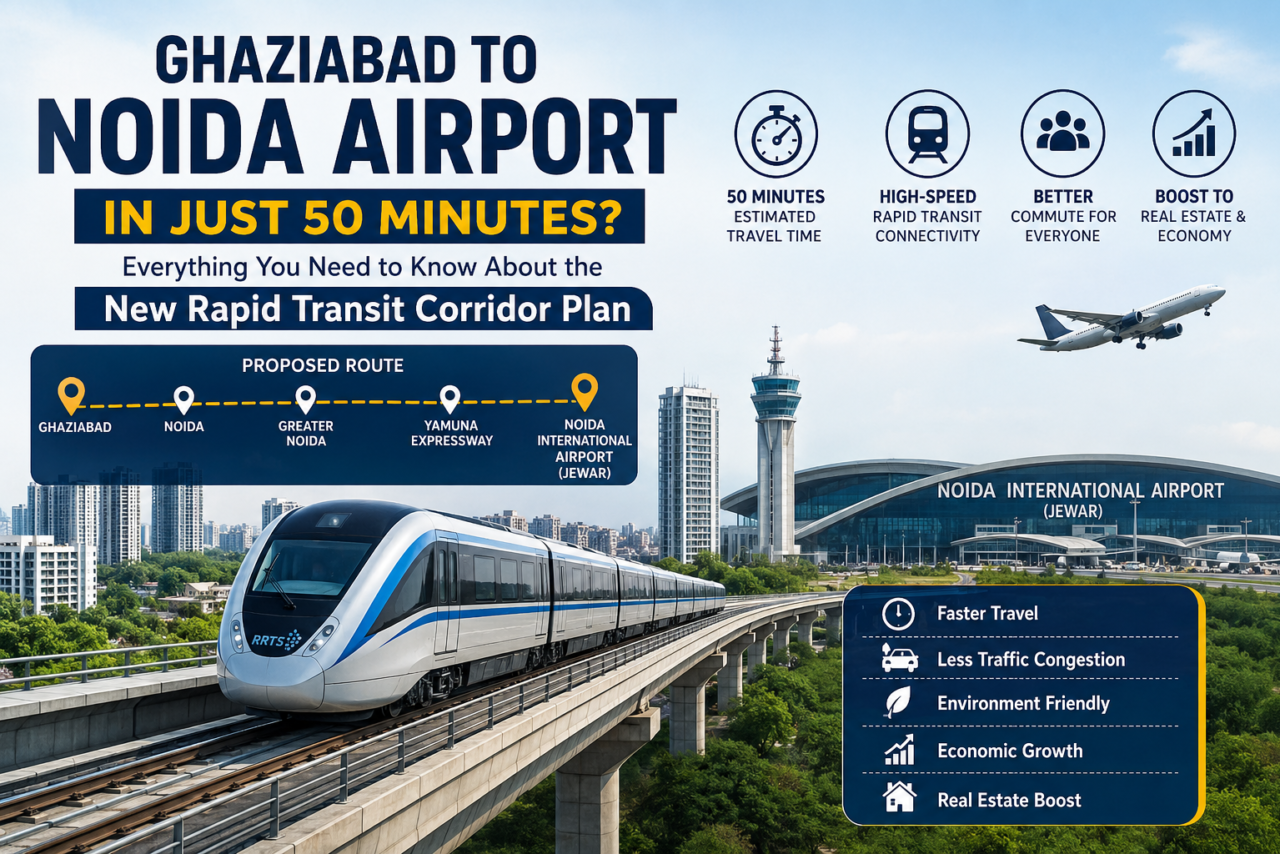

Travel between Ghaziabad and the upcoming Noida International Airport is expected to become much faster in the coming years. A new rapid transit corridor is being planned to improve connectivity between Ghaziabad, Greater Noida, and Jewar. Once completed, this project is expected to reduce travel time to around 50 minutes, making daily commuting and airport access much more convenient.
The proposed corridor is also expected to boost real estate development, improve public transport, and support economic growth across the NCR region. Here’s everything you need to know about this important infrastructure project.
What is the New Rapid Transit Corridor?
The proposed rapid transit corridor is a high-speed regional transport project that aims to connect Ghaziabad directly with Noida International Airport (Jewar Airport). It is expected to become part of the expanding Regional Rapid Transit System (RRTS), which focuses on providing fast, reliable, and comfortable travel across the National Capital Region.
Unlike regular metro services, rapid transit trains are designed to travel at much higher speeds while covering longer distances with fewer stops.
Expected Travel Time
Currently, reaching the upcoming airport from Ghaziabad by road can take anywhere between 90 minutes and over two hours, depending on traffic conditions.
With the proposed rapid transit corridor:
- Estimated travel time may reduce to around 50 minutes
- Traffic congestion on major highways may decrease
- Airport connectivity will become easier for residents and business travelers
- Daily commuting between major NCR cities will improve significantly
This reduction in travel time is expected to benefit thousands of passengers every day.
Proposed Route
Although the final alignment is subject to approval, the planned corridor is expected to connect several important locations across NCR, including:
- Ghaziabad
- Ghaziabad South
- Greater Noida West-Sector IV
- Greater Noida West-Sector II
- Knowledge Park V
- Surajpur
- Pari Chowk
- Ecotech VI
- Dankaur
- YEIDA North-Sector 18
- YEIDA Central-Sector 21
- Jewar Airport
The corridor will integrate with existing metro and rapid rail networks, allowing passengers to switch between different modes of transport with ease.
Why is this Project Important?
The Noida International Airport is expected to become one of India’s largest airports after its completion. Efficient transportation links are essential for handling the expected increase in passenger traffic.
The rapid transit corridor will help:
- Improve airport accessibility
- Reduce dependency on private vehicles
- Lower travel costs
- Minimize road congestion
- Promote environmentally friendly transportation
The project is also expected to support future urban expansion across western Uttar Pradesh.
Impact on Real Estate
Infrastructure projects often play a major role in increasing property demand, and this corridor is expected to be no different.
Areas likely to benefit include:
- Noida
- Greater Noida
- Yamuna Expressway
- Knowledge Park
- Jewar
- Ghaziabad
Better connectivity usually attracts homebuyers, investors, businesses, and commercial developments. Residential projects near transit stations may witness higher demand over the coming years.
Developers are already showing increased interest in locations close to the airport and the proposed transport corridor.
Benefits for Daily Commuters
Thousands of professionals travel daily between Ghaziabad, Noida, and Greater Noida for work.
The rapid transit corridor could offer several advantages:
- Faster office commutes
- Comfortable air-conditioned travel
- Reduced dependence on personal vehicles
- Better punctuality
- Lower fuel expenses
- Less traffic stress
This could significantly improve the quality of life for regular commuters.
Boost for Businesses
Improved transportation often encourages businesses to expand operations.
The new corridor is expected to support:
- Corporate offices
- Logistics companies
- Warehousing
- Retail developments
- Hotels
- Commercial hubs
Easy airport access can also attract multinational companies looking to establish offices near major transport networks.
Support for Tourism
The Noida International Airport is expected to increase domestic and international tourism across Uttar Pradesh and the NCR region.
Faster transportation between Ghaziabad and the airport can benefit:
- Tourists
- Business travelers
- International visitors
- Students
- Families
Improved connectivity will make traveling across the region more convenient.
Current Project Status
The rapid transit corridor is currently in the planning and proposal stage. Various government agencies are studying the feasibility, alignment, and implementation strategy.
After receiving the necessary approvals, the project will move through detailed planning, land acquisition (where required), and construction phases before becoming operational.
As with any major infrastructure project, timelines may change based on approvals and execution progress.
Challenges Ahead
While the project promises significant benefits, several factors will influence its completion:
- Government approvals
- Funding arrangements
- Land acquisition
- Environmental clearances
- Construction timelines
- Integration with existing transport systems
Proper planning will be essential to ensure smooth implementation.
What Does This Mean for Property Buyers?
For homebuyers and investors, improved connectivity often translates into better long-term growth potential.
Locations near the proposed corridor may experience:
- Higher property demand
- Improved infrastructure
- Better rental opportunities
- Increased commercial activity
- Long-term appreciation potential
However, buyers should always evaluate factors such as project approvals, builder reputation, location, and future development plans before making investment decisions.
Conclusion
The proposed rapid transit corridor connecting Ghaziabad to Noida International Airport has the potential to transform regional transportation by reducing travel time to approximately 50 minutes. Along with faster commuting, the project is expected to strengthen economic growth, improve airport accessibility, and encourage real estate development across Ghaziabad, Noida, Greater Noida, and the Yamuna Expressway region.
Although the project is still in the planning phase, it reflects the government’s broader vision of creating a well-connected and future-ready NCR. If implemented as proposed, this corridor could become one of the most important transportation links for residents, businesses, and travelers in the years ahead.


Leave a Reply