


Noida and Greater Noida have changed dramatically over the past few years. What was once primarily known as an industrial and residential destination has gradually developed into one of the important business and real estate hubs of the Delhi-NCR region. However, one major gap has remained: the region has not had a large railway terminal comparable to major Delhi railway stations.
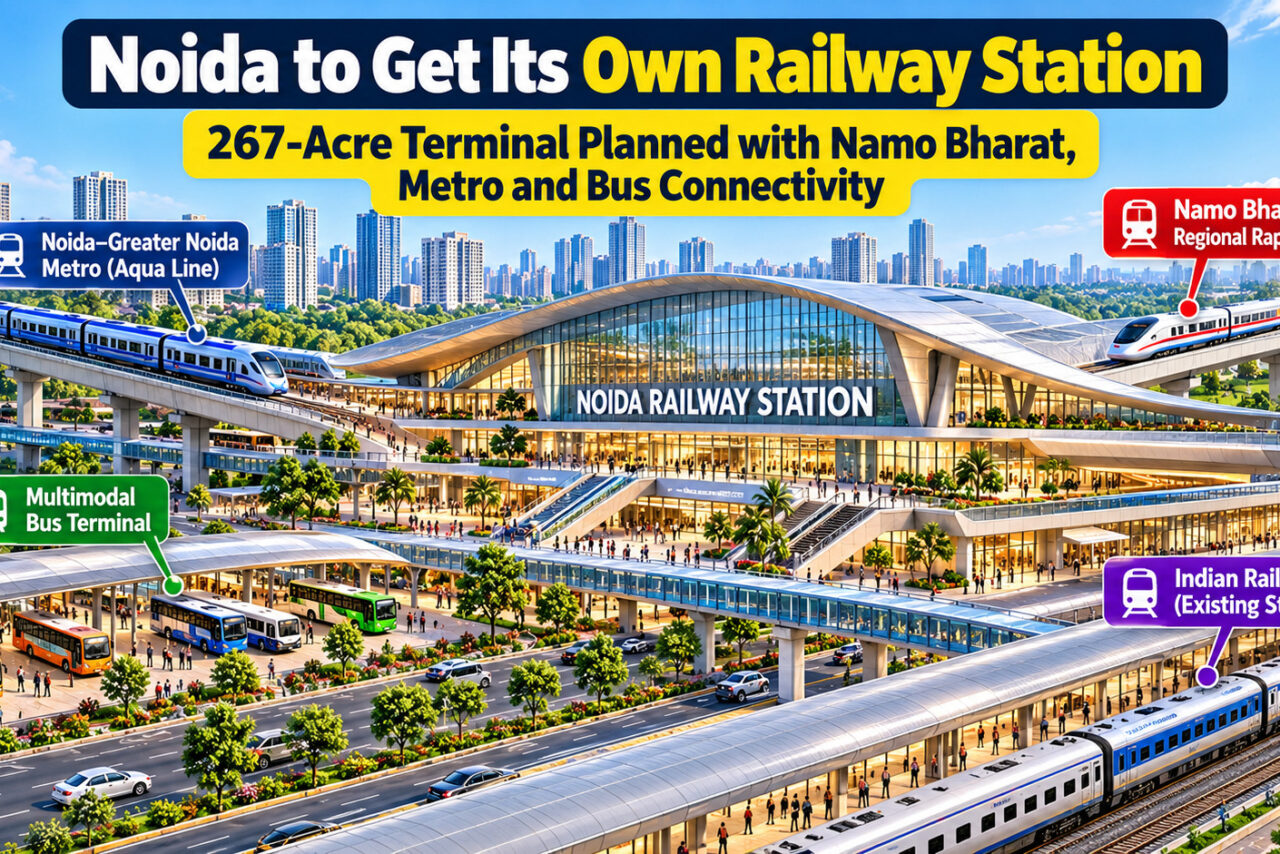
That situation could change with the development of the Bodaki Multi-Modal Transport Hub in Greater Noida. The proposed project is planned as an integrated transportation hub bringing together railway services, Namo Bharat connectivity, metro, interstate buses and commercial facilities at one location. According to the official project description, the Bodaki hub is planned around a modern railway terminus supported by an ISBT, mass rapid transit connectivity and commercial development.
A Major Railway Terminal for the Noida-Greater Noida Region
The proposed railway terminal at Bodaki, near Dadri, is being planned to serve the growing transportation requirements of Greater Noida and the wider Noida region.
Recent reports have described the larger development as a multi-modal complex spread across hundreds of acres, with around 267 acres associated with the planned terminal and transport hub. The railway component is expected to include substantial passenger infrastructure and railway facilities. However, because the project is still under development/planning, the final land-use configuration and specifications should be treated as subject to change.
The idea is not simply to construct another railway station. Instead, the objective is to create a transportation ecosystem where passengers can move conveniently between different modes of public transport.
This approach is increasingly important for fast-growing cities such as Noida and Greater Noida, where daily commuting is closely connected with Delhi, Ghaziabad, industrial areas, expressways and the upcoming Noida International Airport.
Visit Site:- Top 10 Real Estate Consultant In Noida
Designed as a Modern Multi-Modal Transport Hub

One of the most interesting aspects of the Bodaki project is its multi-modal character.
The official project description identifies the proposed hub as a combination of:
- Railway terminal
- Interstate Bus Terminal (ISBT)
- Mass Rapid Transit System (MRTS)
- Commercial and business facilities
- Hotels and shopping facilities
- Passenger amenities
This integrated approach could make the station much more convenient than a conventional railway terminal where passengers have to travel several kilometres to change between different transport systems.
The concept is similar to the modern transport hubs that combine railway, metro, bus and commercial infrastructure at a single destination.
Namo Bharat Connectivity Could Add Another Layer
Another important part of the region’s future transportation network is Namo Bharat.
The National Capital Region Transport Corporation (NCRTC) lists the Ghaziabad–Jewar (Noida Airport) corridor among the Namo Bharat corridors in advanced stages of approval. The proposed corridor is planned to connect Ghaziabad with the Noida International Airport and provide regional rail as well as metro services along the corridor.
According to NCRTC’s current project information, the proposed Ghaziabad–Jewar corridor is approximately 72.44 km long and includes both Namo Bharat and metro services. The exact alignment and station configuration remain subject to final approval.
For the Noida-Greater Noida region, such connectivity could make regional travel more integrated by linking major residential, commercial and employment centres with the airport and wider NCR.
Metro Connectivity Will Improve Local Accessibility
Railway connectivity becomes significantly more useful when passengers can easily reach the station from surrounding residential and commercial areas.
The proposed Bodaki multi-modal hub is therefore planned with mass rapid transit connectivity. Recent reports have also discussed metro connectivity between Greater Noida and the Bodaki terminal.
For residents, this could mean a more convenient last-mile connection. Instead of depending entirely on private vehicles, commuters could potentially use metro services to reach the railway terminal and then continue their journey by train.
This type of connectivity can be particularly useful for students, office workers, business travellers and families travelling between Noida, Greater Noida, Delhi and other parts of North India.
Visit Site:- How Choose Right Property Consultant in India Can Save Your Time and Money
Interstate Bus Terminal to Support Road Connectivity
The proposed hub is also expected to include an Interstate Bus Terminal (ISBT).
According to the official project description, the ISBT is an important component of the multi-modal transport hub, allowing railway passengers and bus travellers to access different modes of transport from the same broader complex.
This could be especially valuable for travellers heading towards cities and towns that are not directly served by convenient rail services.
The integration of rail and bus transport could also reduce the need for passengers to travel into Delhi merely to change transportation modes.
Strong Road Connectivity Around Bodaki
Bodaki’s location is another important factor behind the proposed development.
The area is positioned close to major road networks connecting Greater Noida with Delhi-NCR and surrounding regions. Recent reports have highlighted planned access through major roads and connections towards the Eastern Peripheral Expressway, NH-34, Noida-Greater Noida Expressway and Yamuna Expressway.
This road connectivity could help the proposed terminal function as a regional transportation centre rather than serving only nearby residents.
For people travelling from different parts of Greater Noida, Noida and neighbouring areas, accessibility by road will remain an important part of the project’s success.
Potential Impact on Noida and Greater Noida Real Estate
Large transportation projects often influence the way cities grow.
Better railway, metro, road and airport connectivity can improve accessibility to residential sectors, commercial districts and employment hubs. For Noida and Greater Noida, the combination of existing expressways, metro networks, upcoming airport infrastructure and proposed regional rail connectivity could further strengthen the area’s position within NCR.
For the real estate market, improved connectivity can increase interest in locations that offer convenient access to major transport corridors. However, property prices and investment returns depend on several factors, including project completion, demand, supply, infrastructure execution and broader market conditions.
Therefore, buyers should evaluate individual projects and locations rather than assuming that every property near a proposed transport facility will experience the same impact.
A New Travel Option for Residents
At present, people living in Noida and Greater Noida often use nearby railway stations in Delhi, Ghaziabad and other surrounding locations depending on their destination and train availability. The development of a major terminal closer to Greater Noida could provide another option for long-distance rail travel.
A modern terminal with railway, metro, Namo Bharat and bus connectivity could also make travel more convenient for people visiting cities such as Lucknow, Kanpur, Prayagraj, Varanasi and other destinations on major rail routes, subject to the eventual train services and operational plans.
What Makes the Project Important?
The biggest significance of the proposed Bodaki terminal is its multi-modal approach.
Instead of treating railway, metro, buses and roads as separate systems, the project aims to bring them together around one transportation hub. This is similar to the broader NCR approach of integrating different modes of public transport.
NCRTC’s experience with multi-modal stations also highlights the importance of convenient interchange between Namo Bharat, metro, railway and bus services. Anand Vihar, for example, already brings together railway, metro, ISBT and Namo Bharat connectivity.
What This Could Mean for Noida’s Future
The proposed railway terminal is more than a transportation project. It forms part of a much larger transformation taking place across Noida and Greater Noida.
With the growth of commercial centres, residential communities, expressways, metro connectivity and the upcoming Noida International Airport, the region is gradually developing a more interconnected urban ecosystem.
If the planned railway, Namo Bharat, metro and bus connections are delivered as proposed, Bodaki could become an important regional interchange for passengers travelling across NCR and beyond.
For residents and businesses, better connectivity can mean easier commuting, improved accessibility and stronger links with other major economic centres.
Conclusion
The proposed Bodaki Multi-Modal Transport Hub represents an important step in the long-term transportation planning of the Noida-Greater Noida region. With a large railway terminal planned alongside metro, Namo Bharat, interstate bus and commercial facilities, the project aims to create an integrated transportation destination rather than a standalone railway station.
As Noida and Greater Noida continue to expand, seamless connectivity will become increasingly important. The proposed terminal, together with the region’s expressways, metro network and airport connectivity plans, could play a significant role in shaping how people travel and how the surrounding urban areas develop in the coming years.


Leave a Reply